At the top of the site, I have added a new page entitled "The Men". This will be a living organism. Names will be added as family members email me, and my research continues. Check back often for updates.

2013/02/07

2013/01/23
More on Maj. Balcom
Last week I was able to discover a bit more about Major A.A. Balcom. He was the 24th's first wartime commanding officer (http://24engineers.blogspot.com/2012/12/wartime-commanding-officers.html).
First name: Alonzo
Using the VA's Nationwide Gravesite Locator and the National WWII Memorials Registry, I was able to turn up the following information.
First name: Alonzo
Born: 7/22/1919
Died: 6/8/2000
He was from Baton Rouge, Louisiana, and ended his service in the Army as a Colonel. I am under the impression that he left the 24th for a promotion.
You can see a picture of him here;
http://www.dixiestones.net/details.php/listing/1231
You can see a picture of him here;
http://www.dixiestones.net/details.php/listing/1231
2013/01/20
Pine Camp, NY
After the 4th Armored Division was activated in 1941, the Division, along with the 24th, was sent to Pine Camp, NY for training. Here are the items I have in my collection from that period.
Post card depicting hospital area;


Post card depicting hospital area;


Matchbook cover;

2013/01/14
"A" Co. V. Panzers
During fighting in September of 1944 at Rechicourt, France, "A"/24 and other elements CC"B" came into heavy contact with Kraut armor. But they were no match for the brave men of "A" Company!

An incredible feat.
*Photo of After-Action Report, taken by author. Courtesy of the Eisenhower Presidential Library.
2013/01/09
Map Overlays and the Route to Regan
On recon patrols and other missions, engineers would draw their findings on a map overlay. This was used exactly like a transparency on an overhead projector. They would set it on the map, and there you have a detailed picture of the situation. This is depicted fantastically by Blood on the Talon;
http://castraponere.com/bloodonthetalon/29-jan-45-engineer-overlay-revisited/
This is a picture of an overlay drawn by members of the 24th Arm'd Engr. Bn.
It depicts the route of approach to Regan from Schwandorf, both located in Germany. The green colored line represents the road taken by armor of the division.
It depicts the route of approach to Regan from Schwandorf, both located in Germany. The green colored line represents the road taken by armor of the division.


The Germans also used overlays.
[1] On 13 November 1944, the second platoon of "B" Company captured a vital piece of intelligence at an over-run position of the 1125 Grenadier Regiment (559th Division). It was a map overlay depicting "all minefield locations, type, and number of mines in (word unreadable), bridge defenses." The overlay was sent up to Group HQ.
[1] "After-Action Report, Company B, 24th Armored Engineer Battalion, Period 1 November 1944-30 November 1944. From the Eisenhower Presidential Library.
[1] "After-Action Report, Company B, 24th Armored Engineer Battalion, Period 1 November 1944-30 November 1944. From the Eisenhower Presidential Library.
2013/01/03
Disposition of Units on VE Day
VE Day (Victory in Europe Day), May 8, 1945, marked the end of hostilities against Nazi Germany. The 24th found themselves in Southern Czechoslovakia, along with the rest of the 4th Armored Division.
This map was made using a document that is part of an after-action report. It states the command post locations for each company on VE Day.
You can click on the points to see what elements were located there.
This map was made using a document that is part of an after-action report. It states the command post locations for each company on VE Day.
You can click on the points to see what elements were located there.
View Disposition on VE Day in a larger map
In Memory of ?
On the night of 11 September, 1944, most of Company "B" was committed as infantry to secure a bridgehead. During this action, one of the injuries was the commanding officer of "B" Co. He was evacuated to an aid station, and returned to his duties on the16th.
Only 8 days after returning to duty, the 24th received a heavy enemy counter-attack south-west of Chateu-Salins, France. One of the unfortunate casualties of this action was the C/O of "B".
Now, you are wondering why I titled this "In Memory of ?" . I did this because his name is never mentioned in any reports. He is, unfortunately, another name lost to the ages.
In memory of "B" Company Commanding Officer
24th Armored Engineer Battalion
KIA 24 September 1944
Anonymous, but not forgotten
2012/12/28
Wartime Commanding Officers
During the War, the 24th had three commanding officers. The first wartime C/O (commanding officer) was

The second C/O was

Their third and final wartime C/O was
- Major A. A. Balcom, Jr.

The second C/O was
- Major Donald W. Hatch

Their third and final wartime C/O was
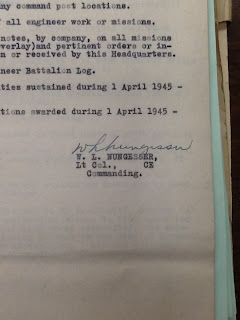
- Lt. Col. W. L. Nungesser
He also was the C/O during their occupation duties after the war. He took command of the 24th at some point after the Battle of the Bulge. Previously, he held the command of the 168th Engineer Combat Battalion.

Photos taken by author of documents contained in the Eisenhower Presidential Library.
2012/12/27
Duties of Armored Engineers
Combat
engineer training was some of the most advanced military training
of the day. It included many aspects. Everything from clearing
roads to reconnaissance patrols and beyond. All of these duties were
accomplished in addition to the duties of an infantryman. The 24th sustained many casualties in this role alone.
Engineer
training took approximately [1]574 hours, and it was conducted at
Camp Mackall, North Carolina.
In this post, I will go over some of the more common duties armored
engineers were called on to accomplish, as well as give examples from
primary source reports. They will be told from the point of view of
the other units about the work their engineers did for them. All
examples will be about the 24th
Armored Engineer Battalion (of course!).
Some
of the most dangerous work the engineers did was that of clearing
minefields. On the way to Stein Bockenheim, Germany [2]“Mines at
the crossroads help up the advance of the force until it could be
cleaned out... and engineers removed the mines under cover of the
infantry deployed ahead of the minefield.” And just like
they removed mines, they also planted them for Germans.
Armored engineers also had the vital job of keeping the roadways
passable for advancing armor and infantry. This includes tanks that
have been hit, and are blocking roadways. This is the reason they
almost always had a platoon of engineers close to the front of an
advancing column. They used Armored Recovery Vehicles, however it
was not uncommon for them to use bulldozers as well. During the
assault on Malbergweich, Germany the main road going north to south
[3]”was mined and A/37 had three tanks damaged at the
crossroads...the damaged vehicles formed a road block holding up the
company for time time. After the engineers cleared the road, “A”
Company succeeded in getting though the woods.” Occasionally there
would be craters from artillery and other explosives in the roadways
rendering them impassible for advancing armor. [4]”At 0930 an
impassible road crater was reported 2Km west of Ferle, and the
engineers started to bridge it.”
One obstacle the columns were constantly facing was streams and
river. They needed a bridge; however, the Germans were good at
blowing them to bits. The most commonly used bridging material used
by the 24th seemed to be inflatable pontoons. They could
be inflated fairly quickly to allow infantry across, and treadways
could be attached to allow light tanks and trucks to cross. On April
2, 1945 they ran into the Werra River at Creuzberg, Germany.
[5]”Engineers were brought up, and under the protection of a
rail-road grade, they inflated a pontoon which after being taken to
the river, served as a ferry to move the infantry across.” They
ended up putting treadways on these pontoons, with some complications, later in the day.
When infantry was needed across the river immediately, it was the
engineers responsibility to get them there. One of the commonly used
method was inflatable pontoon boats. When the 10th
Armored Infantry Battalion arrived at the bridghead west of Kunitz,
Germany, the bridges were all blown. [5]”Infantry was shuttled
across river in rubber ponton boat, cleaned Kunitz taking
approximately 150 PW's.” One of the most famous examples of this
would be the Waal River crossing made by 3/504 Parachute Infantry.
“C” Company of the 307th Airborne Engineer Battalion
used their boats and men to take them across.
Another especially high risk job of the engineers was participating
in reconnaissance patrols in advance of armor and infantry columns.
They would look for things that needed to be done so they could plan
their work, as well as see thing from a “mobility” point of view.
On 13 March, 1945 [6]“A
task force composed of D/37, assault guns of 37th and 10th, and a platoon of B/24 moved to the vicinity of Mahren, swept the area for possible enemy, and found it occupied by friendly service forces.” This time they made no contact with German forces however, they were not often this lucky.
Knowing their duties of obviously critical to understanding these men and their actions during the war. I hope you found this information as useful as I did. Writing it was a blast.
task force composed of D/37, assault guns of 37th and 10th, and a platoon of B/24 moved to the vicinity of Mahren, swept the area for possible enemy, and found it occupied by friendly service forces.” This time they made no contact with German forces however, they were not often this lucky.
Knowing their duties of obviously critical to understanding these men and their actions during the war. I hope you found this information as useful as I did. Writing it was a blast.
Sources
[1]
“Basic Airborne Engineer Training”, Blood
on the Talon, 2012.
(http://castraponere.com/bloodonthetalon/basic-airborne-engineer-training/)
[2],
[5] After-Action Report, 51st Armored Infantry
Battalion, 23 Aug. 1944 though 9 May 1945, P.5 Courtesy of the
National Archives and Records Administration
[3]
“After-Action Report for month of March, 1945”, 37th
Tank Battalion. P.6 Courtesy of the National Archives and Records
Administration
[4]After-Action Report, 51st Armored Infantry Battalion, 23 Aug. 1944
though 9 May 1945, P.26 Courtesy of the National Archives and Records
Administration
[5]“After-Action Report for month of March, 1945”, 37th
Tank Battalion. P.4 Courtesy of the National Archives and Records
Administration
[6]“After-Action Report for month of March, 1945”, 37th
Tank Battalion. P.7 Courtesy of the National Archives and Records
Administration
2012/12/24
Seeking Veterans, Pictures, and Other Information
If you, someone you know, or a family member served with the 24th during World War Two, please contact me. It would be my honor to do a post about him.
I am also seeking pictures of the 24th Engineers, if you have any please don't hesitate to contact me as well. They are a researchers best friend. I will give proper credit where required.
Through this blog, I hope many family members will contact me so we can get the story of these brave men out.
How CAN we remember when we don't know WHAT to remember?
bloodontherisers2@gmail.com
I am also seeking pictures of the 24th Engineers, if you have any please don't hesitate to contact me as well. They are a researchers best friend. I will give proper credit where required.
Through this blog, I hope many family members will contact me so we can get the story of these brave men out.
How CAN we remember when we don't know WHAT to remember?
bloodontherisers2
Subscribe to:
Posts (Atom)